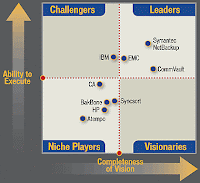
 The company's Siebel unit is the sole Leader in a recent Gartner Magic Quadrant and its Oracle E-Business Suite lands on the cusp; ClickSoftware and TOA Technologies are listed as Visionaries.
Growing demand is driving change in the field service management (FSM) industry -- vendors whose products enable mobile workforce optimization, fleet routing and management, technician portals, and asset monitoring -- even as the number of players within it shrinks. An estimated 40 percent of technicians in large enterprises will have wireless access to FSM by 2012, up from 12 percent today, according to a report by research firm Gartner. The addition of CRM functionality to FSM solutions will be used as a way to enable field service technicians to capture sales leads, configure orders, and market while on site. But more than half of all FSM suppliers will merge with, be acquired by, or acquire another supplier by 2012, according to Gartner. It is against that backdrop that Gartner presented its 2008 Magic Quadrant for Field Service Management.
As in many other corners of CRM and related industries, the growth of software-as-a-service (SaaS) is becoming a factor to consider. Gartner predicts that, by 2012, at least 30 percent of new FSM application components will be sold using the SaaS delivery model, rather than as purchased software licenses. Despite that, two of the leading products in the FSM space have limited or no SaaS options.
Oracle's Siebel Systems, the sole resident of the Leader quadrant, is no stranger to acquisition; Oracle is the most notorious acquirer and Siebel its most notable acquisition in recent years. "Siebel design and configuration tools are best-of-breed," writes Michael Maoz, Gartner vice president and distinguished analyst, in the report. "References report that the scalability of the application can support thousands of technicians comfortably." While Maoz notes that the Siebel product shows "continued investment in functionality and technology, deeper integration with the Oracle technology stack and...ongoing recruitment of development, sales, and marketing resources," he cautions against the cost and complexity of implementation, and also its lack of either real-time capabilities or a Web-based option.
Oracle's other FSM-capable product, E-Business Suite, is almost precisely in the center of Gartner's chart. Its strengths include good reference designs for project management, a strong background in asset management, and notable mobility tools, according to Gartner. Weaknesses include difficulties in procurement, a reliance on other Oracle products, and the aforementioned lack of SaaS, as well as a relatively small customer base and little experience with complex operations.
Two companies occupy this year's Visionaries quadrant (those with relatively complete market vision but less ability to execute):
* ClickSoftware; and
* TOA Technologies.
Gartner notes that ClickSoftware "is the largest independent software company offering field service optimization...[and] a growing company with the advantage of focus on a core service business problem." However, its solution is described as incomplete. TOA Technologies tripled its customer base from 4,000 last year to 12,000 this year, making it the fastest-growing vendor in this Magic Quadrant. Gartner hails its ETAdirect product as "the only multitenant, Internet-based, SaaS offering on the FSM Magic Quadrant. It attacks a high-value, high-cost activity: service technician travel and work." TOA is a small company, though, with a narrow focus within the telecommunications industry.
Three companies were added to the list of vendors this year:
* IFS
* Vertical Solutions, and
* WennSoft.
All appear in the Niche Players quadrant, alongside more established players:
* SAP;
* Corrigo;
* Astea International;
* Ventyx;
* ServicePower; and
* Syclo.
One company, @Road, was dropped from the 2008 chart; "We have not seen software modernization of the workforce optimization application, or partners and a sales force actively selling and deploying the product" is the reason quoted in the report.
Notable by its absence is Microsoft. "Microsoft has tremendous long-term potential in this area, but it is unlikely to muster the focus required to build a credible business during the next 12 months," Maoz writes. "It will remain consumed by other priorities, such as communications, CRM, ERP applications for small and midsize businesses, and mobility."
Author: Marshall Lager @ www.destinationcrm.com
Read more ...


 Qtrax, a free, legal peer-to-peer music service with an ad-supported delivery model, has implemented Oracle's infrastructure software to provide better IT architecture necessary to deliver its global service.


![[CNW:Counter]](https://lh3.googleusercontent.com/blogger_img_proxy/AEn0k_t4DPZaUjeis8Y4i57TWyy5Ay_MKHaCZ46xx8rkgfDQdR3RhIjIF-Q8eBBTUESIVegz1OI_9etDzXsycuaMbcA5pyaAWNm33mI6nRYglkSTdlKy9xxBeOsxnvdXHA=s0-d)


