24.1.12

Oracle Database Book and eBook Published: Boost Performance with the Oracle Database 11gR2 Performance Tuning Cookbook
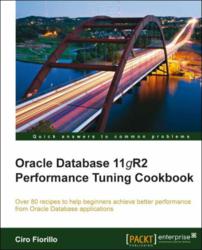
Packt Publishing, one of the world’s leading Publishers of Oracle Training material, is pleased to announce the publication of Oracle Database 11gR2 Performance Tuning Cookbook, a new book and ebook aimed at newcomers to the Oracle Database seeking to solve performance problems faster and in a rigorous way. 

Birmingham: Packt Publishing, one of the world’s leading Publishers of Oracle Training material, is pleased to announce the publication of Oracle Database 11gR2 Performance Tuning Cookbook, a new book and ebook aimed at newcomers to the Oracle Database seeking to solve performance problems faster and in a rigorous way.

Written in a cookbook style by Cirol Fiorillo, Oracle Database 11gR2 Performance Tuning Cookbook is filled with real recipes offering solutions starting from application design and development, through the implementation of well-performing applications, to the details of deployment and delivering best-performance databases. Readers will learn to implement fast and scalable SQL and PL/SQL code, and choose the correct structures to store the data and access them.
Each recipe in the book is based on a script/procedure explained step-by-step, and is aimed at software developers, software and data architects, and DBAs who work with the Oracle Database.
Packt Publishing has developed and published many books on the Oracle Database, and some of the recent titles include:
  •     Oracle Information Integration, Migration, and Consolidation
  •     OCA Oracle Database 11g: SQL Fundamentals I: A Real World Certification Guide (1ZO-051)
  •     Oracle 10g/11g Data and Database Management Utilities
  •     Oracle Database 11g – Underground Advice for Database Administrators
  •     Mastering Oracle Scheduler in Oracle 11g Databases
  •     And many more. All Packt’s Oracle books can be found on the Oracle books page.

 Source: http://www.prweb.com


Read more ...

2.1.12

Ellison’s son is an Oracle of movie hits

When “Mission: Impossible — Ghost Protocol” topped the box office last weekend, it was a surprising outcome to many.

But for the 28-year-old son of Oracle CEO Larry Ellison, the film’s success was a vindication of his early support for the project that led him to finance half of its $145 million budget.

The latest “Mission: Impossible” film is just one of several movies being co-financed by Paramount and Skydance, the production and financing company started by Larry Ellison’s son, David.

Skydance gives Paramount a way to share the risk on big-budget films or movies with uncertain commercial prospects.

When Skydance finalized its deal with Paramount in 2010, the studio had been without a long-term financing partner since 2008. In the interim, the studio had been relying on various companies like Spyglass.

But Paramount still had a strong track record at the box office, which, along with the fact that the studio seemed to be looking for a strategic partner, appealed to David Ellison.

A source close to the deal says the studio reached an agreement with Ellison in part because execs discovered they and the Oracle scion had very similar tastes.

But another source familiar with the situation indicated that the fact that David was Larry Ellison’s son made Paramount feel like he was a reliable investor.

Indeed, Larry Ellison supplied an undisclosed amount of the $150 million in equity Skydance raised. Skydance also put together $200 million in a revolving -credit facility led by JPMorgan.

Paramount offers films it wants Skydance to co-finance to Ellison’s company early in their development. The percentage of the budget Skydance finances depends on the film.

The partnership has provided Paramount with a way to hedge their bets on risky movies like the Coen brothers’ Western, “True Grit”; Skydance financed 50 percent of its $38 million budget.

More recently, Skydance stepped in to help finance Paramount’s reportedly pricey zombie film, “World War Z.” The deal also gives Paramount an option to distribute movies that Skydance develops.

Source: HILARY LEWIS @ http://www.nypost.com/


Read more ...

19.12.11

Oracle, Cisco crow new database flash dash record

Best 2-CPU server result ever - with Violin's chips. Oracle claims a world-record TPC-C result with its database running on a Cisco server and not an Exadata system, although doesn't mention that two Violin memory flash arrays were needed.

A Cisco UCS C250 extended memory server with two six-core Xeon X5690 processors, 384GB of DRAM, and two Violin Memory flash arrays (5.3TB V-3205 and 16.3TB V-6000) ran Oracle's 11g database on Oracle Linux, and scored 1,053,100 transactions per minute (tpmC), with a cost per transaction of $0.58.

This was the third lowest cost-per-tpmC ever, only being beaten by the $0.49/tpmC and $0.51/tpmC of two four-processor HP Proliant systems running SQL Server. The $0.51/tpmC result used six Violin Memory V3200 flash arrays, each with with 2.6TB of flash. The $0.49 HP result used flash as well; HP P2000 array with 128 300GB SAS disk drives and D2700 enclosure with 256 120GB SSDs.

Oracle says its tech "delivered more performance, and cost nearly 11 per cent less per tpmC than the nearest competition on a configuration using identical Intel processors and memory capacity", referring to an HP result of 1,024,380 tpmC and $0.65/tpmC with a ProLiant DL380. This server featured 81 400GB SSDs plus 104 disk drives.

Both Cisco's and Oracle's canned quotes somehow forgot to mention the Violin arrays, which was somewhat surprising as the Violin storage represented the vast majority of the $602,316 bill for the tested configuration.

Kevin Closson, a technology director and performance architect in the Data Computing Division of EMC, tweeted about the result, saying: "Style: Get world record result and don't mention key storage technology that made it possible. See the word Violin?"

He also said that Violin doesn't mention Oracle on its benchmark result page, which is not quite true; the Violin page has a hot-link to the Cisco UCS tpmC result which does mention Oracle.

Source: Chris Mellor @ http://www.theregister.co.uk


Read more ...